

Like many of us, I’ve spent decades learning the ins and outs of programming languages. Mastering the syntax, exploring the design space, and indulging in neat idioms. Little of that knowledge is directly useful today; LLMs are good at syntax, and while they still might have some way to go before writing fully idiomatic code, perhaps that last mile no longer matters as much. Are all those years of painstaking learning wasted?
No, not necessarily. By immersing ourselves in code we hone our problem solving and sharpen our cognition. Code becomes a way of thinking rather than a medium for instructing a compiler. Those skills seem to transfer quite well. In fact, the shift might not be as large as we perceive.
How big is the shift?
I recently attended the excellent GOTO Copenhagen conference. I was fortunate enough to be on a panel focusing on agentic coding. During the panel, the moderator asked the audience a question along the lines of “How many feel depressed now with AI coding?”. Roughly 25% of the audience raised their hand, and there were 1000+ dev in attendance.
And we don’t have to go to conference polls to realize that a large portion of developers have lost their motivation and feel threatened:
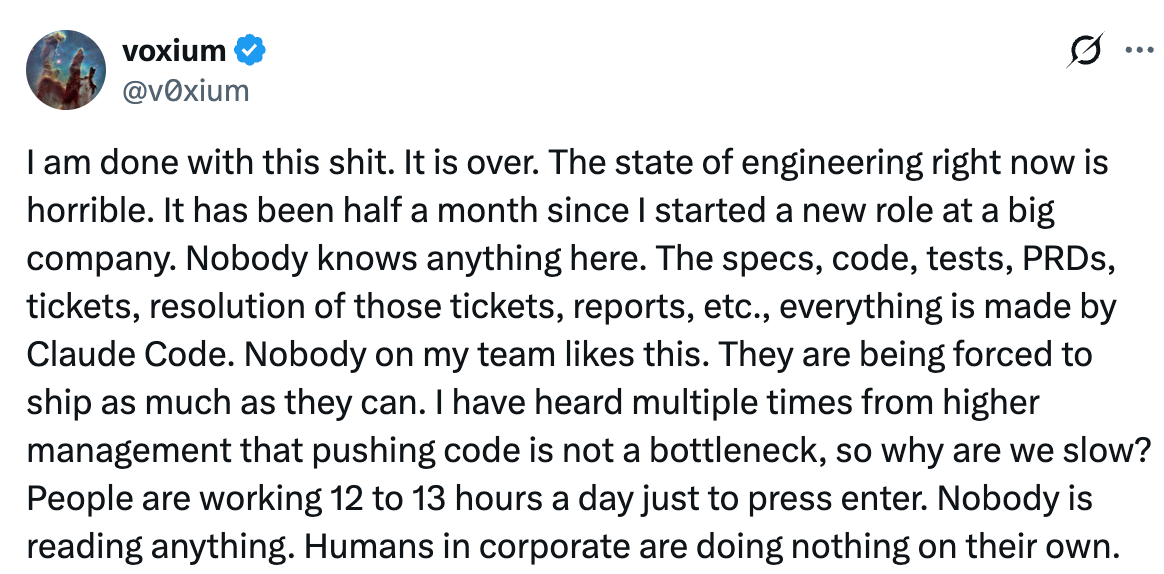
What’s surprising, though, is that coding was never our main job. Back in 2015 — a decade before any Claudes or Copilots — research showed that coding only represented 5% of a developer’s work week.
If we didn’t write much code a decade ago, what did we spend time on? The majority of the time — 70% — was spent trying to understand the existing codebase. Not that different from today, is it?
Granted, when I share this view I tend to get push back: if coding was only 5%, how come programming feels so different without it?
I suspect that it is because agents automated the disproportionately fun part. Few people enjoyed digging through walls of code to find the relevant parts to change. Even fewer enjoyed haunting the halls of a large corporation to find someone that could explain how a specific feature was actually supposed to work. But coding? Everyone loved that.
Now that coding is gone, what value does our experience still bring? Let me show you by an example.
Coding shapes cognition: a real-life example
Recently, a colleague and I teamed up on a new feature. That feature involved iterating over a large data set and augmenting each entry with some additional metadata.
Our tests passed after the first agentic iteration, giving confidence that the code was functionally correct. Wonderful. But given that it was brand new code, we jumped on a huddle to do some quick spot checks. We immediately noticed a problem: the AI-generated code re-read and re-parsed the whole data set on each pass. That would have been a performance disaster, and is the kind of mistake a senior dev would rarely do.
Yes, we would have observed and noticed that problem later via production data, but the damage would have been done.
There are two takeaways:
As experienced coders, we spotted the pattern quickly. Just like a speed reader consumes text in patterns rather than word by word, a strong manual coding background has trained us to spot algorithmic weaknesses and flaws. Those skills are clear advantages when skimming over chunks of generated code.
The less we control the implementation, the more important it is to control the characteristics we depend upon. Perhaps we need to include automated performance checks for all code, not just the ones we’d normally consider the hot path. It sounds expensive, but the alternative might be worse.
Sure, we could always hope these problems are transient, perhaps resolved via better and even larger future models. But I don’t want to run a nuclear power plant in my backyard just to generate a decent for-loop. Rather than betting on the next generation models, I’m aiming for workflows and harnesses that let us work with the current generation. Those workflows do need skilled people in the loop at the right time and place. This is where programmer experience plays a key role.
The value of experience
Experience lets us build a strong intuition that helps identify potential implementation risks. The problem with intuition, though, is that it doesn’t scale. Nor is it feasible to have newcomers code manually for 10+ years to grow that experience. Instead, the way forward is most likely to capture experience as enforceable constraints. (One example of how that can look in practice is architectural fitness functions as described in Building Evolutionary Architectures by Ford, Parsons, and Kua).
Performance is just one example. More generally, we need to find sustainable ways to automate other non-functional requirements, too. And that’s a road where our experience could be translated into value.
In my obligatory Coding Is Dead (…But It Still Smells Funny) post, I captured some trends I’m seeing. One was around an emerging developer role that I call The Enabler.
The enabler is responsible for the meta-layer of development. Think: all the work that makes agentic development effective. Part of that role would be what we traditionally called DevEx like optimizing delivery pipelines, improving testability, etc. But given that the focus isn’t on human devs this time, the majority of the role would be around enhancing the agentic feedback loops. And trust me on this one: there’s more than enough engineering work to be done here.
Better yet, we are now able to perform that work using an entirely new toolbox. Or, rather, old tools that just weren’t accessible in practice before.
Expanding our toolbox
Quick, how many times have you heard the cliche of using the right tool for the job? There’s obviously truth to it, but it used to be the kind of non-actionable advice that sounds smart yet is hard to act upon.
Yes, a beautiful awk one-liner could probably make those sweeping changes to the text document in a much cleaner way than the 200 lines of Python I end up with. But Python I already know, and just getting the basics of awk requires an intense day of study. Worse: I need to know that awk exists in the first place to even consider it.
Coding agents change all of that. An AI has a different view of complexity than humans. Let me give you an example.
The product I work on uses multiple languages: Clojure, TypeScript, Rust, and various databases for production, and then the Python ecosystem for the research projects I work on. I always struggled when shifting technology in the middle of a task, needing a transition period before I stopped wrapping TypeScript expressions in those dreaded Lisp parens. An agent never struggles: it transitions seamlessly across infrastructure updates, backend logic, DB queries, and frontend code.
All these tools and languages are now accessible, meaning we developers get a chance to broaden our skill sets. No, we won’t master them all at the level we used to conquer our programming language of choice. But we get to build a powerful arsenal.
Personally, the last year has been rewarding. I’ve got to explore more technologies than ever before, and finally built significant projects in both Rust and Go. Two languages I always wanted to master, but never could invest the time to become fluent enough at. That is the rewarding side of AI.
A dying skill I expected to miss
Early in my AI journey, I expected to miss the mental gymnastics of wiring code together. Solving a complex problem with relatively simple code was always rewarding.
But interestingly enough, I haven’t really missed the coding part. That might be because I’ve already written more than enough code for a lifetime...and then some. (Those first years with my startup were intense). Or, it might be a more general trajectory that most devs go through.
Yes, our personal capacity for writing, reading, and understanding code at the syntax level will inevitably deteriorate. But what determines our success, relevance, and future enjoyment is what we compensate with.
For me, agentic coding is enjoyable because it lets me take on larger parts of a problem than I would have been able to master manually. Infrastructure updates are no longer a blocker. And I don’t need to spend time learning about a build system I never cared about.
My personal goal is to get better at working with higher-level abstractions, and accept that writing code is likely to be a dying skill. My bet on the future is that our problem solving skills, logical mindset, and understanding of systems will be at least as rewarding.
In the end, we only need to challenge our identity if we mistake programming for writing code. AI finally allows us to separate the two. And that’s where all those years of experience transfer the best: knowing not only what to build but how to build it well.